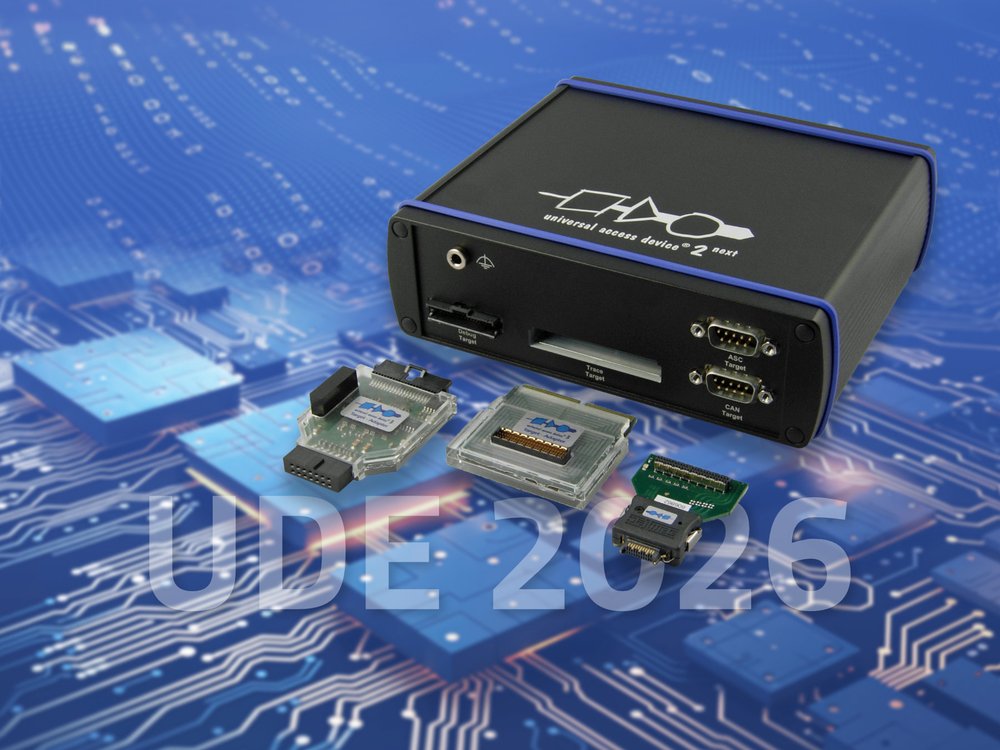
UDE® 2026 offers even greater ease of use with new functions
Press Release
Lauta (Germany), January 15, 2026
Featuring a wide range of new functions designed to streamline debugging and trace-based analysis of complex microcontroller applications, PLS Programmierbare Logik & Systeme is unveiling the major release UDE® 2026 of the Universal Debug Engine at embedded world 2026 in Nuremberg in Hall 4, Booth 4-310. At the same time, the portfolio of supported high-end microcontrollers and embedded processors has been significantly expanded once again.
To provide developers with a particularly easy-to-use and at the same time highly efficient tool for debugging, tracing, and testing embedded software on microcontrollers and embedded processors, the CPU utilization function has been expanded for the runtime analysis of RTOS and AUTOSAR-based applications, among other things. As of now on, the data for the calculation can be determined not only by the trace system of the respective microcontroller, but also by sampling via the debug interface. While this method may offer slightly lower statistical accuracy, it provides a significant benefit by enabling the assessment of CPU utilization for MCUs lacking trace support.
Additional operating system hooks defined in the AUTOSAR Runtime Interfaces (ARTI) enable an even more detailed visualization of the runtime behavior of AUTOSAR applications. UDE utilizes these to display service calls and spinlocks in addition to tasks and interrupts in the execution sequence chart. This facilitates a more precise analysis of application and operating system behavior, making it easier to identify any performance issues.
To facilitate the development of scripts used to automate debugging tasks and software tests using the popular Python scripting language, PLS's UDE 2026 also offers its own script debugger within the integrated Python console. This feature enables breakpoints and single-stepping in Python code, along with the display of Python variables within a dedicated watch window.
In addition, special enhancements and adaptations were made to the UDE 2026 for individual MCU families and devices such as the Infineon AURIX™ TC4Dx, the first member of the TC4x family. For example, trace support has been extended for monitoring the runtime of virtualized applications, which means that virtual machines managed by the TC4x hardware hypervisor are now also visible in the trace records. In addition, UDE 2026 now also supports trace functions for the so-called production devices. This offers the great advantage of enabling trace recording during both the development phase using emulation devices, which may be cost-intensive, and in the field using standard MCUs.
However, due to hardware limitations, the trace functionality is restricted in terms of the available trace memory size and only allows a single trace recording after a restart or reset of the application, respectively, controller.
For the AURIX™ TC3xx -based TTControl control units of the TTC 2300 and TTC 2030 series, PLS's UDE 2026 also offers preconfigured target configurations that provide users of these ECUs with a ready-to-work debug environment without the need for the respective developer to make ECU-specific configurations beforehand.
Many of the architectures, device families, and embedded processors newly supported by PLS also benefit from the further optimized test, debug, and trace functions of the UDE 2026. A focus is on controllers based on Arm® Cortex® cores, such as the S32K5 automotive MCUs from NXP, the STM32H5 MCU from STMicroelectronics, the MSPM0 and MSPM33 mixed-signal industrial microcontrollers from Texas Instruments, the latest MCU generation of the Infineon MOTIX™ family, and the multi-core automotive MCUs of the THA6 Gen2 series from Chinese chip manufacturer Tongxin Micro. For the open RISC-V architecture, PLS has implemented support for the AndesStar™ V5 32-bit architecture from Andes. The first users are already using UDE® for software development on the AndesCore™ D23 core based on it.
The broad market launch of UDE® 2026 is planned for the beginning of May this year.